Are AI phone calls legal? Recording, disclosure and consent
Aniket SinghGuides10 min readUpdated

Are AI phone calls legal? In general, yes: businesses in the US and UK can use AI to answer and make calls. But a few rules shape how you do it. You need consent before an AI voice calls people in many situations, you need to handle call recording the way your state or country requires, and you should be honest with callers that they are talking to AI.
This article is general information, not legal advice. Laws differ by country and state, they change, and how they apply depends on your facts. Use this as a starting point for a conversation with a lawyer who knows your industry and location.
Below we cover the difference between inbound and outbound AI calls, the FCC's February 2024 ruling on AI-generated voices, US recording consent rules, UK data protection basics, and a checklist you can work through.
Key takeaways
- In February 2024 the FCC confirmed that AI-generated voices count as "artificial" voices under the Telephone Consumer Protection Act (TCPA). Outbound calls using them generally need the called party's prior express consent.
- Federal US law allows recording with one party's consent, but several states require everyone on the call to consent. A clear notice at the start of the call is the common way businesses handle this.
- In the UK, the ICO says you must tell people you are recording a call and why. Automated marketing calls need specific consent.
- Be open about AI. Telling callers they are speaking with an AI receptionist is good practice, and rules on AI disclosure are still developing.
- Ask a lawyer about your specific situation, especially if you call across state lines, call other countries, or handle health or financial information.
Are AI phone calls legal? Inbound vs outbound
Most rules about AI on the phone depend on who placed the call.
- Inbound calls are customers calling you. An AI receptionist answers, helps and records the call. The main legal questions here are recording consent, privacy, and being honest about what the caller is talking to.
- Outbound calls are you calling customers or leads. If an AI voice places the call, US robocall rules come into play, alongside recording and privacy rules.
The FCC's 2024 ruling is framed around outbound calls. It says its requirements apply to "any AI technology that initiates any outbound telephone call using an artificial or prerecorded voice to consumers." It does not address an AI answering calls that customers choose to place to you. Recording and privacy rules still apply to inbound calls, though, so inbound is not a free pass.
If you are new to how these tools work, our guide to what an AI receptionist is explains the basics.
The TCPA and the FCC's February 2024 ruling on AI voices
The Telephone Consumer Protection Act is the main US federal law on unwanted calls. Among other things, it restricts calls made using an "artificial or prerecorded voice."
On February 8, 2024, the FCC released a Declaratory Ruling (FCC 24-17), adopted unanimously on February 2. It confirmed that the TCPA's restrictions on artificial or prerecorded voices cover current AI technologies that generate human voices, including voice cloning. In plain terms, the ruling says:
- Consent first. Callers must obtain the called party's prior express consent before making a call that uses an AI-generated voice, unless there is an emergency purpose or an exemption applies.
- Written consent for marketing. If the call includes an advertisement or is telemarketing, FCC rules require prior express written consent.
- Identify yourself. Artificial or prerecorded voice messages must clearly identify the business responsible for the call at the start, along with other required information.
- Opt-out for marketing calls. Where the call is telemarketing, it must offer a way for the person to ask not to be called again.
- No live-agent loophole. The ruling says the TCPA does not carve out technologies that claim to be the equivalent of a live agent.
Separately, FCC rules bar telephone solicitations to residential subscribers before 8 am or after 9 pm, local time at the called party's location.
In August 2024 the FCC went further and released a Notice of Proposed Rulemaking (FCC 24-84). It proposed defining "AI-generated call" and requiring callers using AI-generated voices to disclose that at the start of each call. These were proposals when published. Check their current status before relying on them.
What this means for a small business
Suppose a customer calls your salon, asks for a callback tomorrow, and gives their number. An AI calling them back about that request is a very different situation from an AI dialing a purchased list of strangers. The first has a clear request behind it; the second is the kind of call the TCPA was written to stop.
Even so, "they asked us to call" is something you should be able to show. Keep a record of how and when people agreed to be called. If you use an AI receptionist's scheduled callbacks, the call summary and transcript of the original call can help. Our guide to scheduling follow-up calls covers calling hours and retries.
Telling callers they are talking to AI
Being honest about AI is good practice and is where regulation appears to be heading. It also tends to go better with callers. People are more forgiving of an AI that says what it is than one they suspect is pretending.
Practical ways to do it:
- Have the greeting say what it is, for example: "Hi, you've reached Maple Dental. I'm Ava, the practice's AI assistant. How can I help?"
- Make sure the AI answers truthfully if asked. BookifyCall's agent tells the truth when a caller asks whether it is an AI.
- Offer a route to a person for urgent or sensitive calls, such as a transfer or a callback.
- Do not use a cloned voice of a real person without their clear permission.
Rules on AI disclosure are still developing at federal and state level, and outside the US. Ask your lawyer what currently applies where you and your callers are.
Call recording consent laws in the US
AI receptionists usually record calls to produce transcripts and summaries. That brings in wiretap and eavesdropping laws, which come in two broad types.
| One-party consent | All-party consent | |
|---|---|---|
| Rule | A call can be recorded if one person on it consents (which can be the person or business recording) | Everyone on the call must consent |
| Where | Federal law and most states, for example New York | A minority of states, for example California, Florida, Illinois, Maryland, Massachusetts, Pennsylvania and Washington |
| Common practice | Many businesses still announce recording | Announce recording at the start so callers can choose to continue or hang up |
The federal Wiretap Act (18 U.S.C. § 2511(2)(d)) allows a person who is a party to a call, or who has one party's prior consent, to record it, unless it is for a criminal or tortious purpose. State laws can be stricter.
Lists of all-party states vary by source because some state laws have nuances. A July 2024 overview from the law firm Kilpatrick Townsend, Wiretap Laws in the United States, also lists Connecticut, Delaware, Montana, Nevada, New Hampshire and Oregon. Other summaries treat some of those differently, or add Michigan in certain circumstances. That disagreement is a good reason to check with a lawyer.
Calls across state lines
Callers do not always live in your state. When one side is in a one-party state and the other in an all-party state, the Kilpatrick Townsend overview notes that the strictest standard generally applies, and recommends complying with the strictest applicable law or getting consent from everyone.
For most small businesses the practical answer is the same: announce the recording at the start of the call. A short line such as "This call may be recorded so we can follow up accurately" works. Continuing after a clear notice is commonly treated as consent, but whether that is enough in your situation is a question for your lawyer. Check whether your phone provider can play a notice like this automatically.
UK and GDPR basics
In the UK, call recordings and the details an AI receptionist captures (names, numbers, reasons for calling) are personal data. The UK GDPR and the Privacy and Electronic Communications Regulations (PECR) apply. The Information Commissioner's Office (ICO) is the regulator.
The core points:
- Have a lawful basis. You need a valid lawful basis, such as legitimate interests or contract, for recording and keeping call data.
- Tell people. The ICO's guidance on monitoring calls says you must tell people you are recording the call and why, and that a recorded message is good practice.
- Be proportionate. The same guidance says it is not usually proportionate to record the content of calls in all cases, so be clear about why you record.
- Explain in your privacy notice what you collect, why, how long you keep it and who you share it with.
- Automated marketing calls need specific consent. The ICO's telephone marketing guidance says general consent for marketing, or even consent to live calls, is not enough for automated calls.
Several ICO pages note that their guidance is under review following the Data (Use and Access) Act, so check the current versions. The EU GDPR shares the same core principles of lawful basis and transparency, but member states add their own rules.
Health, legal and other sensitive calls
Some businesses hear sensitive information on the phone: health details at a clinic, case details at a law firm, financial details at an accountant. Extra rules may apply, such as HIPAA for some US health providers.
BookifyCall does not claim HIPAA compliance. If you run a clinic or dental office, talk to your compliance adviser before any phone system records or summarizes patient calls, and set up your AI receptionist to avoid collecting more than it needs. Our guide for dental offices, clinics and salons covers practical privacy care.
A practical checklist for AI on business calls
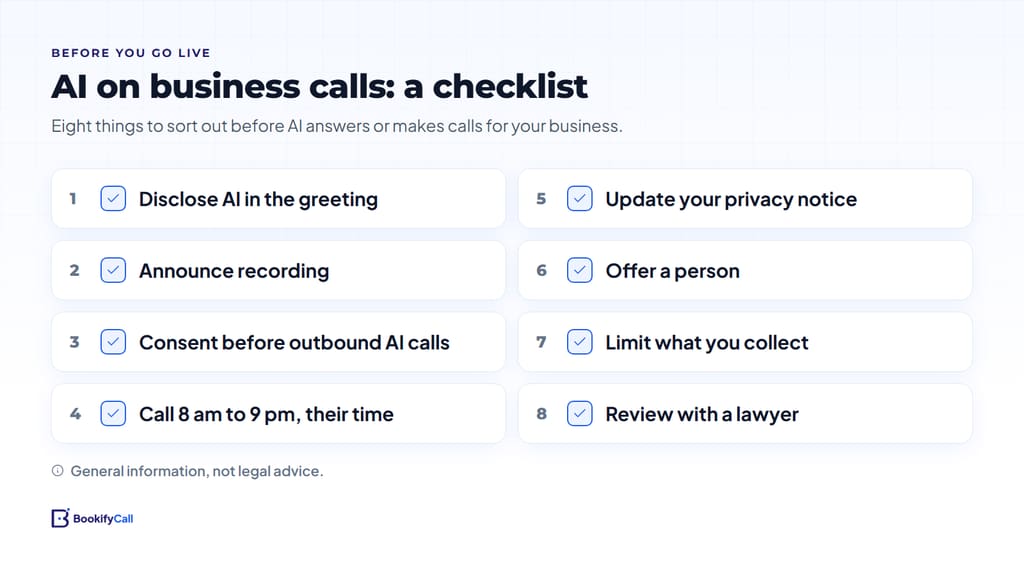
- Disclose AI. Name the assistant as AI in the greeting, and make sure it answers truthfully if asked.
- Announce recording. Play or say a short recording notice at the start of calls.
- Get consent before outbound AI calls. Only have AI call people who have agreed to be called, and keep a record of when and how they agreed. Use written consent for anything that counts as marketing.
- Respect calling hours. Keep calls between 8 am and 9 pm in the contact's local time.
- Update your privacy notice. Say that calls may be answered by AI and recorded, why, how long you keep recordings and who processes them.
- Offer a person. Give callers a way to reach a human or leave a message for urgent or sensitive matters.
- Limit what you collect. Tell the AI what it should not ask for or repeat. Our checklist of what to tell your AI receptionist includes a "never say" list.
- Review with a lawyer. Especially before calling across state lines or internationally, or if you work in a regulated industry.
Questions to bring to your lawyer
- Which recording consent rules apply given where we and our callers are located?
- Is our recording notice worded and timed well enough?
- Which of our outbound calls need prior express consent, and which need written consent?
- Do any AI disclosure rules apply to us now, at federal, state or local level?
- How long should we keep recordings and transcripts, and who should be able to access them?
- Do industry rules (health, legal, finance) change any of the above?
If you want to see how an AI receptionist handles greetings, recordings and transfers before you speak to your lawyer, the BookifyCall help center explains the settings, and you can contact our team with questions about how the product works.
Frequently asked questions
Is it legal to use an AI receptionist to answer calls?
Generally, yes. The FCC's 2024 ruling on AI voices is framed around outbound calls. For inbound calls you still need to follow recording consent and privacy rules, and being open about AI is good practice. This is general information, not legal advice.
Do I have to tell callers they are talking to AI?
Disclosure rules are still developing. The FCC proposed in 2024 that AI-generated outbound calls disclose AI use at the start, and other rules may apply where you operate. Telling callers is the safer and more honest default.
Do I need consent to record business calls?
It depends on location. US federal law and most states require one party's consent, while some states, such as California, require everyone's consent. In the UK you must tell callers you are recording and why. A clear notice at the start of the call is the usual approach.
Can an AI call my leads back?
It can, but in the US an AI-voice call generally needs the person's prior express consent, and marketing calls need written consent. Call only people who asked to hear from you, keep a record, and stay within 8 am to 9 pm their time.
Does the TCPA apply to calls to other countries?
The TCPA is a US law. Calls to people in other countries are covered by those countries' rules, such as PECR and the UK GDPR in the UK. Check with a lawyer before calling internationally.
Using AI on business calls is workable for most small businesses when you get the basics right: be honest about AI, announce recordings, get consent before AI calls anyone, and keep good records. The specifics depend on where you and your callers are, so treat this guide as a checklist to take to a lawyer, not a substitute for one. For more on choosing the right set-up, see our comparison of AI receptionists, answering services and voicemail.