
The cost of missed calls: how to work out yours
Aniket SinghGuides9 min readUpdated

The cost of missed calls is the revenue from callers who would have booked with you but went somewhere else because nobody picked up. You can estimate it with one line of math: missed calls per week, times the share of those callers who would have booked, times your average booking value, times 52 weeks. The result is rarely exact, but it tells you whether missed calls are a rounding error or a real leak.
This guide walks through the formula, two worked examples with made-up numbers, how to count your own missed calls and the fixes worth trying, starting with the cheapest.
Key takeaways
- Annual cost of missed calls = missed calls per week × share who would have booked × average booking value × 52.
- Count only real missed calls. Spam, wrong numbers and existing customers who call back don't belong in the first number.
- Be conservative with the "would have booked" share. A lower honest estimate beats a dramatic guess.
- Your phone logs, voicemail and Google Business Profile give you most of the data for free.
- Fixes range from a better voicemail greeting to a full-time hire. Compare each fix's cost with your number.
The missed call formula
Here is the whole calculation. Each input is something you can estimate from your own business in a few minutes, and refine later with real data.
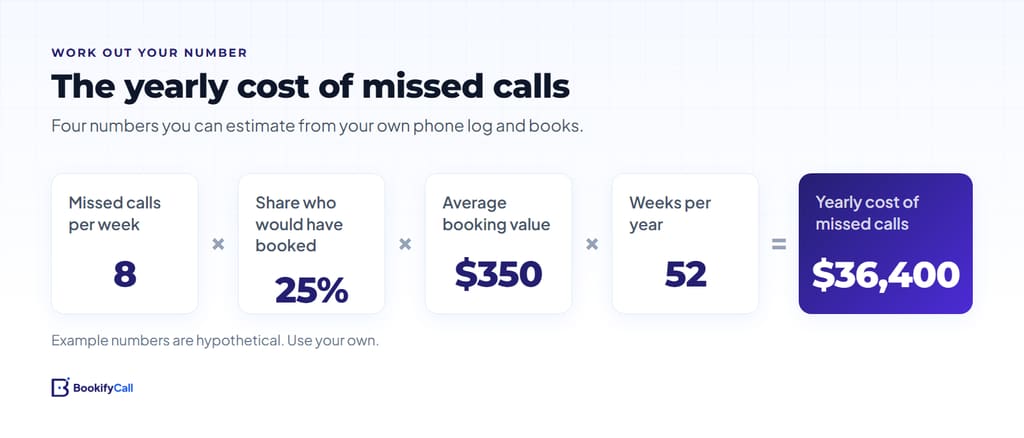
1. Missed calls per week
This is the number of calls from potential customers that went unanswered or straight to voicemail. Include after-hours calls, calls during jobs or appointments, and calls when the line was busy. Leave out robocalls and obvious spam, which can make up a large part of an unanswered list.
2. Share who would have booked
Not every caller is a sale. Some are shopping around, some want a service you don't offer and some only have a quick question. Think about the calls you do answer: out of ten new-customer calls, how many end in a booking? Use that rate, then shade it down a little, because people who reach voicemail have already had a worse experience.
3. Average booking value
Use the typical value of a first job or appointment, not your best-ever ticket. If customers usually come back, you can run the formula a second time with a yearly customer value instead. Keep the two numbers separate so you know which one you are looking at.
4. Weeks in a year
Multiply by 52 to get a yearly figure. If your business is seasonal, run it separately for busy and quiet months and add them up. A heating company's January looks nothing like its May.
Two worked examples
The numbers below are hypothetical. They are not industry averages and they don't describe any real business. They show how the formula behaves, so swap in your own figures.
Example 1: a two-person plumbing business
Imagine a plumber who misses about 8 new-customer calls a week, mostly while on jobs and after 6 pm. When they do answer, roughly a third of new callers book. They shade that down to 25% for voicemail callers. An average first job is $350.
8 × 0.25 × $350 × 52 = $36,400 a year in first jobs that likely went to a competitor.
Example 2: a three-chair salon
Now imagine a salon that misses about 12 calls a week while stylists have their hands full. About 30% of those callers would have booked, and an average appointment is $65.
12 × 0.30 × $65 × 52 = $12,168 a year in first appointments. If a new client typically returns four times a year, the yearly customer value is $260, and the same formula gives $48,672 in lost client value.
| Input (hypothetical) | Plumber | Salon |
|---|---|---|
| Missed new-customer calls per week | 8 | 12 |
| Share who would have booked | 25% | 30% |
| Average first booking value | $350 | $65 |
| Yearly cost, first bookings only | $36,400 | $12,168 |
| Yearly cost, using customer value | Not calculated | $48,672 (at $260 per client per year) |
Two things stand out. First, a small number of missed calls can matter when each booking is worth a few hundred dollars. Second, the "would have booked" share swings the result more than anything else. Halve it and the cost halves. That is why it pays to measure rather than guess.
How to measure your missed calls
You probably already have the data. It just lives in a few different places. Pick a normal two-week stretch and pull from these sources.
Your phone or carrier call log
Most mobile phones, VoIP systems and business phone services keep a log of missed and answered calls. Export or screenshot two weeks of it. Mark each missed call as new customer, existing customer, spam or unknown. Calling back a sample of the unknowns tells you a lot.
Your voicemail
Compare the number of voicemails with the number of missed calls. The gap is the group of people who hung up without leaving a message, which is often the larger group. Those callers are the hardest to win back, because you may not know what they wanted.
Google Business Profile and ads
If customers find you on Google, your profile's Performance page shows how often people tap to call. Google notes that this metric counts the number of times a customer clicked on the call button on your Business Profile, so it measures demand rather than answered calls. Comparing it with your own answered-call count gives you a rough miss rate for those callers. If you run Google Ads with call reporting, call reporting shows details such as call duration, start time and whether the call was connected.
Filter out the noise
Unwanted calls inflate your missed-call count. The FTC's guide on how to block unwanted calls covers carrier call-labeling and blocking tools. It also notes that blocking can sometimes catch calls you want, so check what your filter is stopping before you rely on it.
Note when the misses happen
While you tally, write down the time of each missed call. Patterns show up fast: lunchtime, the first hour of the day, evenings, Saturdays. The timing tells you which fix makes sense, because a lunchtime gap and an overnight gap have different solutions.
Why the cost of missed calls is easy to underestimate
The formula only counts the first booking. In practice a missed call can cost more in ways that are harder to measure.
- The caller often moves on. Someone with a burst pipe or a broken AC unit usually calls the next business on the list rather than waiting for a callback.
- Repeat business goes with them. A new salon or dental client who books elsewhere may stay elsewhere for years.
- Callbacks take time. Returning calls eats into your evening, and many end in voicemail tag. Our guide to follow-up calls that connect covers timing and retries if you do call back.
- Existing customers notice too. A regular who can't reach you to reschedule may simply not show up.
None of these show up neatly in a spreadsheet, so treat your formula result as a floor rather than a ceiling.
Fixes for missed calls, from cheapest up
Once you have a yearly number, compare it with what each fix costs in money and time. Start at the top of the list and stop when the gap is covered.
| Fix | Typical cost | What it solves | Limits |
|---|---|---|---|
| Better voicemail greeting plus fast callbacks | Free, but costs your time | Some callers leave details instead of hanging up | Many callers still won't leave a message |
| Accurate hours and booking link on your Google profile and website | Free | Fewer calls asking basic questions; some people book online | Doesn't help callers who want to talk |
| Forward or ring the office line to several phones | Low | Whoever is free can pick up | Interrupts the team; nobody may be free |
| AI receptionist | Monthly subscription | Answers, books and takes details around the clock; transfers urgent calls | Only knows what you tell it; some callers want a human |
| Live answering service | Per minute or per call, often with a monthly minimum | A human takes messages and sometimes books | Cost grows with volume; agents may know little about your business |
| Part-time or full-time receptionist | Wages, payroll taxes and benefits | A person who knows your business, plus other front-desk work | Covers only their working hours |
For context on that last row, the US Bureau of Labor Statistics reports a median receptionist wage of $18.27 an hour (May 2025 data). That is before payroll taxes and benefits, and it only covers the hours someone is at the desk.
Many businesses combine fixes. A common pattern is to ring your own phones first and let an AI receptionist pick up if nobody answers. In BookifyCall this is an optional setting that rings up to five of your phones in order before the AI answers. We explain how to set that up in ring your team first, then the AI. For a side-by-side look at the human and AI options, see AI receptionist vs answering service vs voicemail.
Put your number next to the cost of a fix
Here is a quick way to decide. Take your yearly missed-call cost, using the conservative version. Then take the yearly cost of the fix you are considering. If the fix costs a small fraction of the number, and you trust your inputs, it is probably worth trying. If the two are close, improve your measurement before spending anything.
Run the test for a month and measure again. Did the number of unanswered new-customer calls drop? Did bookings from phone calls rise? A fix that doesn't change those two numbers isn't working, however good it sounds.
If an AI receptionist is on your list, our plain-English guide to what an AI receptionist is and how it works covers what to expect. BookifyCall answers calls around the clock, books into Google Calendar or Calendly and sends you a summary of each call, so you can see exactly which calls it caught. Plans are on the pricing page, and the 14-day trial doesn't need a credit card, which makes it easy to run your own before-and-after test.
Frequently asked questions
What counts as a missed call for this formula?
Any call from a potential new customer that nobody answered live, including calls that went to voicemail and calls during busy-line moments. Leave out spam, wrong numbers and existing customers, or track existing customers separately.
How many missed calls is normal for a small business?
It depends heavily on your trade, team size and hours, and reliable cross-industry figures are hard to find. Your own two-week tally is far more useful than any average, because it reflects your callers and your schedule.
Should I use first booking value or lifetime customer value?
Run both. First booking value gives you a conservative floor that is easy to defend. Customer value shows the bigger picture for businesses with repeat clients, such as salons, clinics and dental offices.
Is calling back missed calls enough?
It helps, especially if you call back quickly. But it only works for callers who left a message or whose number you recognize, and it takes your time. Many callers who hang up have already called someone else.
How accurate is the missed call formula?
It is an estimate, and the "would have booked" share is the weakest input. Use your answered-call booking rate as a guide, be conservative and refine the number after a few weeks of real tracking.
Missed calls are easy to shrug off because you never see the customer you lost. Ten minutes with your call log and the formula above turns that into a number you can act on. If it is small, you can stop worrying about it. If it is large, you now know how much a fix is worth to you. For trade-specific ideas, see how other businesses handle this for home services and salons and clinics.