
AI receptionist for property management: emergencies and showings
Aniket SinghIndustries10 min read

An AI receptionist for property management answers your office line when the office is closed or the team is out at a property. It tells a tenant with a real emergency what to do first and puts them through to your on-call person. Routine maintenance requests get written down in full for the office, and prospects can book showings into your calendar during the call. It answers from the details you give it, so tenants and prospects get answers from the same details, whoever calls and whenever they call.
Whether you call it a property management answering service or a maintenance request line, most of the setup is a decision you already make in your head at 2 am: is this an emergency, or can it wait until morning? This guide turns that decision into rules an AI can follow for after-hours maintenance calls, and it is honest about what the AI can't do.
Key takeaways
- Write your emergency list first: no heat in cold weather, burst pipes, water through a ceiling, no water, sewage backups, and lockouts if you handle them. Everything else becomes a request for the office.
- Where safety is at risk (gas smell, fire, a carbon monoxide alarm, water near electrics), the caller hears "call 911 or the utility first." Then the AI takes the details and transfers to on-call.
- Routine requests reach you as a summary, transcript and email. The AI doesn't open work orders in property management software; your team does that.
- Prospects can book showings into Google Calendar or Calendly while they're on the phone.
- It answers from one written set of details, so each prospect hears the same rent, deposit and pet policy.
- It can't take rent payments. It tells callers how to pay.
The calls a property management office gets
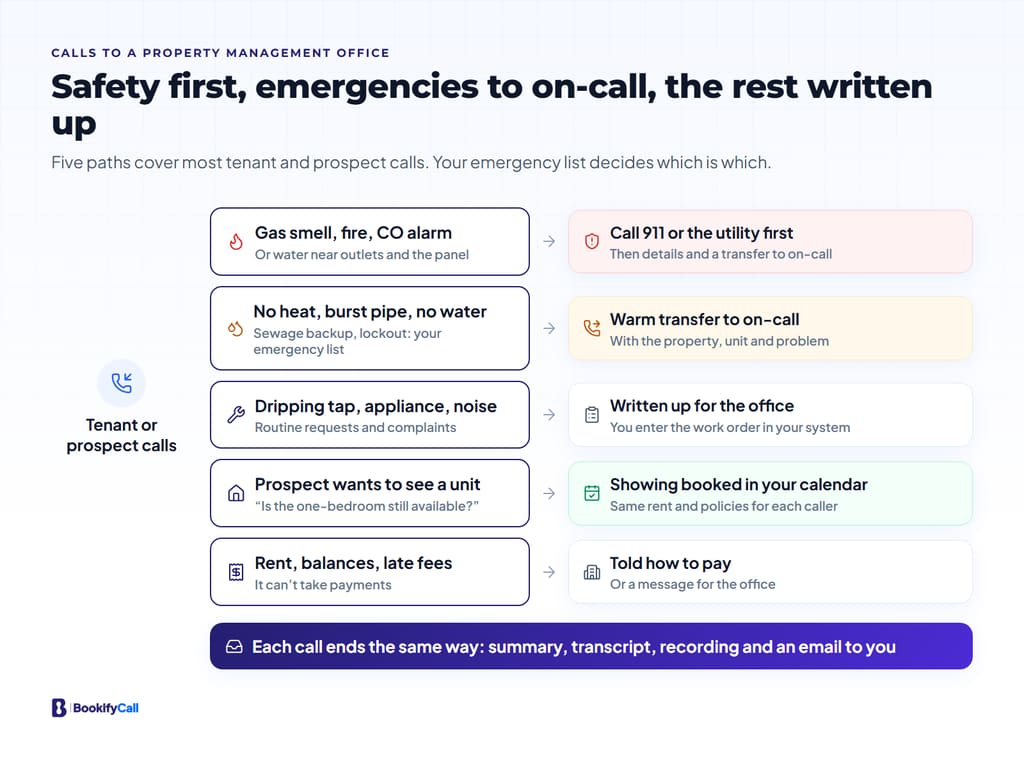
A small property management company hears from four groups: tenants, prospects, owners and vendors. Tenant maintenance calls are the ones that keep you up at night, because the urgent ones don't arrive in office hours. Here is how the usual calls split between the AI and a person.
| Call | What the AI does | When a person takes over |
|---|---|---|
| Gas smell, smoke or fire, carbon monoxide alarm | Tells the caller to get out and call 911 or the gas utility from outside, then takes the address | Right away, to on-call, after the safety message |
| Burst pipe, water coming through a ceiling | Takes the property, unit and what's happening; gives the shut-off location if you've told it | Right away, to on-call |
| No heat in cold weather, no water, sewage backup | Takes the unit, the problem and who is affected | Right away, when it matches your emergency list |
| Lockout | Explains your lockout policy and any fee, takes the unit | To on-call, or as your policy says |
| Dripping tap, broken appliance, slow drain | Takes the problem, permission to enter and the best times | The office follows up |
| Noise complaint | Takes the details for the office; tells the caller to call 911 if anyone is threatened | The office, or the police for threats |
| "Is the two-bedroom still available? Can I see it?" | Answers from your listing details, books a showing | No |
| Rent, balances, late fees | Says it can't take payments, explains how to pay, takes a message | The office, in business hours |
Write your emergency list before anything else
An AI receptionist follows your rules. It doesn't decide on its own that a leak is bad enough to wake someone. So the most useful thing you can write is a short list of what counts as an emergency, with the conditions that make it one.
- No heat. Say when it's urgent: below a set outdoor temperature, or during your local heating season. Local rules vary. New York City, for example, requires at least 68°F indoors during the day when it's below 55°F outside, and at least 62°F overnight, from October 1 to May 31. Write the rule for your area.
- Water. Burst pipes, active leaks, water through a ceiling, no water at all, a sewage backup.
- Security. A broken exterior door or window that leaves a unit open.
- Lockouts. Only if you handle them after hours, with the fee and how long someone usually takes.
Then write the "not tonight" list: dripping taps, appliances, slow drains, pests, parking, cooling in mild weather. Tell the AI what tenants should expect, in words you can keep: "The office will contact you on the next business day." A tenant who hears a clear plan rarely calls back three times.
Safety first: 911 or the utility comes before on-call
For a gas smell, the first step is getting people out, not a transfer. The US Pipeline and Hazardous Materials Safety Administration's guidance is to leave the area, avoid switches, and call 911 from a neighbor's house or other location well away from the leak. Write your own short version and tell the AI to say it before anything else. Do the same for smoke or fire, a carbon monoxide alarm, and water near outlets or the electrical panel.
After the safety message, the AI takes the address and transfers to your on-call person, who may need to meet the fire department or the utility. An AI receptionist answers your business line. It isn't an emergency service, and your instructions should say so.
On-call transfers that reach someone
BookifyCall transfers calls to the contacts you add (the number depends on your plan). With warm transfer, the AI briefs your on-call person before connecting the caller, so they pick up already knowing "48 Elm, unit 3C, water coming through the bathroom ceiling, tenant has turned off the main valve."
- Keep the on-call contact current. If the rotation changes weekly, updating the transfer contact goes on the same handover list as the on-call phone.
- Add a backup. The owner or a second manager, so urgent calls have somewhere else to go.
- Answer yourself when you can. BookifyCall can ring up to five of your own phones in order, for 10 to 60 seconds each, optionally only in business hours. If nobody picks up, the AI answers and thanks the caller for holding.
- Plan for storm nights. A freeze can set off a run of burst-pipe calls. When all your lines are busy, you choose whether callers leave a message, get forwarded or hold.
Routine maintenance requests: what the office gets
Most maintenance calls aren't emergencies, but a vague message ("something's wrong with the sink") still costs your team a callback. Tell the AI to collect what your technician needs:
- Name, property, unit and the best callback number
- The problem in the tenant's words, where it is in the unit, and since when
- Permission to enter, pets, and the best times for a visit
After the call you get a summary, the full transcript, a recording, the caller's details and the outcome, plus an email. That's where the AI's job ends. BookifyCall doesn't connect to property management software, so it can't open a work order, look up its status or tell a tenant when the plumber is coming. Someone on your team enters the request in your system. Have the AI say so honestly: "I've passed this to the office, and they'll set up your repair."
Calls asking "when is someone coming?" work the same way: the AI takes a message for the office, or transfers in business hours.
Give each prospect the same answers
Prospect calls are predictable: rent, deposit, application fee, pets, parking, utilities, lease length, move-in date and how to apply. Write those down once per property and the AI answers from them on each call, at 9 am or 9 pm.
Consistency matters for more than convenience. The Fair Housing Act, as the US Department of Justice explains, prohibits discrimination by landlords and real estate companies based on race, color, religion, sex, national origin, familial status and disability. Some practical rules for the AI's instructions (general information, not legal advice):
- Give the same rent, fees, deposit and requirements to all callers.
- Leave screening questions out. Point callers to your written application process instead.
- Don't describe "who lives here" or whether a building suits families. Stick to the unit and the amenities.
- Keep the vacancy list current and delete units as they lease.
If you also sell homes, the call mix is different. Our post on how real estate agents catch buyer calls while showing homes covers that side.
Booking showings into your calendar
BookifyCall checks your Google Calendar's real free and busy times during the call, offers open slots and books one. Calendly works too. The prospect's name, number and the unit they asked about come through in the summary. The mechanics are in how AI phone booking works with Google Calendar and Calendly.
- Allow drive time. Block travel between properties so the AI can't stack two showings across town.
- Respect current tenants. If your lease or local law requires notice before showing an occupied unit, block the next few days for that unit in your calendar, so the AI only offers showings after the notice period.
- Book a showing, not a unit. The AI can't see your leasing software, so it books a visit and you confirm the unit is still free. Self-storage facilities plan around the same limit; see our self-storage guide.
Rent and payment calls
BookifyCall doesn't take payments. Tell the AI how tenants can pay (your portal, autopay, the office) and to say so early. If a caller starts reading out a card number, the AI should stop them and point them to the right way to pay. Balance disputes, late fees and anything involving notices or legal steps should reach a person in business hours.
What an AI receptionist isn't right for
- Work inside your systems. No work orders, tenant ledgers or portal changes. It captures the request; you enter it.
- Diagnosis and dispatch. It can ask the questions you give it, but it doesn't troubleshoot or send vendors.
- Emergencies on its own. It gives your safety message and transfers. It doesn't replace 911.
- Hard conversations. Evictions, disputes and upset owners belong with you.
- Large portfolios with staffed dispatch. If you already run a 24-hour desk, it may suit overflow only.
For the general picture, see our AI receptionist overview and how it works.
Example call walkthrough
This is a made-up call to a fictional company, to show how the setup sounds.
AI: Thanks for calling Maple Row Property Management, this is Jordan. How can I help?
Caller: Water is dripping through my bathroom ceiling. I'm in 3C at 48 Elm.
AI: I'm sorry, let's get someone on it. Is any water near outlets or lights?
Caller: No, just the tub area.
AI: Thanks. The main water shut-off for your unit is under the kitchen sink. Are you able to turn it off?
Caller: Okay, done.
AI: Good. I'm connecting you to our on-call manager now and letting them know what's happening.
(The AI briefs the on-call manager: 48 Elm, 3C, water through the bathroom ceiling, away from electrics, main valve off. Then it connects the caller.)
The next morning a prospect calls about the one-bedroom on Pine Street. The AI gives the rent, deposit and pet policy you wrote, offers two showing times on Saturday and books one. You get both summaries by email.
Setup checklist
- Your emergency list, with conditions, and your "not tonight" list
- A short safety message for gas, fire, carbon monoxide and water near electrics
- An on-call transfer contact and a backup
- Shut-off locations, only if you're comfortable sharing them
- Per-property details: rent, fees, deposit, pets, parking, utilities, how to apply
- How tenants pay, and that the AI can't take payments
- A connected calendar with showing lengths and travel time
- A few test calls, then a week of reading summaries. Our checklist of what to tell your AI receptionist helps with structure.
Frequently asked questions
Can it create work orders in my property management software?
No. BookifyCall doesn't connect to property management software. It collects the request, and you get a summary, transcript, recording and email so your team can enter the work order.
How does it know a maintenance call is an emergency?
From the list you write, such as no heat below a set temperature, active leaks or sewage backups. Calls that match are transferred to your on-call contact with the reason. Everything else is taken down for the office.
What does it do if a tenant smells gas?
It gives your safety message first: leave the building and call 911 or the gas utility from outside. Then it takes the address and transfers to your on-call person. It isn't an emergency service.
Can it answer tenants who speak Spanish or other languages?
Yes. Multi-language calls are included on every plan. Make a few test calls in each language before you rely on it.
Will tenants know they're talking to an AI?
If a caller asks, it tells the truth. You name the agent and choose its voice, and it answers in your company's name.
Can I keep my office number?
Yes. You get a dedicated BookifyCall number and can forward your existing line to it, so the number tenants already have stays the same.
Start with your emergency list, one reliable on-call contact and the details for your vacant units, then listen to a week of calls. BookifyCall has a 14-day free trial with no credit card required, and plans are on the pricing page. To hear an AI receptionist first, call our demo line at (860) 955-9240.